April 11, 2026 • Celeste Morrow • 12 min reading time • Prices verified June 6, 2026
Spring Faux Stems for Indoor Vases: Tulips, Cherry Blossom, and Ranunculus Realism Compared
If you’ve ever bought a bunch of artificial flowers — meaning flowers made from silk, latex, or plastic rather than grown in soil — and been disappointed that they looked obviously fake up close, you’re not alone. The difference between a $9 stem and a $38 stem from a serious brand isn’t always visible in a product thumbnail, and that gap matters enormously when the stem is sitting in a glass vase on your dining table where everyone can see it from arm’s length. This guide focuses on three of the most popular spring choices for indoor vases: tulips, cherry blossom branches, and ranunculus (a ruffled, layered bloom that looks like a peony’s more compact cousin). We’ll compare how convincingly each flower type can be replicated in faux form, what specific construction details to look for at each price point, and which one is the smartest buy for your particular situation — whether that’s a single statement vase or a coordinated spring refresh across multiple rooms.
| EDITOR'S PICK[Sggvecsy 30 Pcs Fake Tulips Art…](https://www.amazon.com/dp/B0D6GQ3PJ3?tag=greenflower20-20) | Mid-tierMandy's White Artificial Tulips… | Budget pick5 Stems Artificial Silk Ranuncu… | |
|---|---|---|---|
| Stem Count | 30 | 20 | 5 |
| Material | PU | PU | Silk |
| Height | — | 13.5" | 23" |
| UV Resistant | — | — | ✓ |
| Bendable Stems | — | — | ✓ |
| Color Options | — | White | Orange |
| Price | $21.99 | $19.99 | $14.99 |
| See on Amazon → | See on Amazon → | See on Amazon → |
Why These Three Stems Perform Very Differently as Faux Flowers
Not all flowers are equally forgiving to replicate in synthetic materials. Understanding why matters for your buying decision before we get into tier-by-tier comparisons.
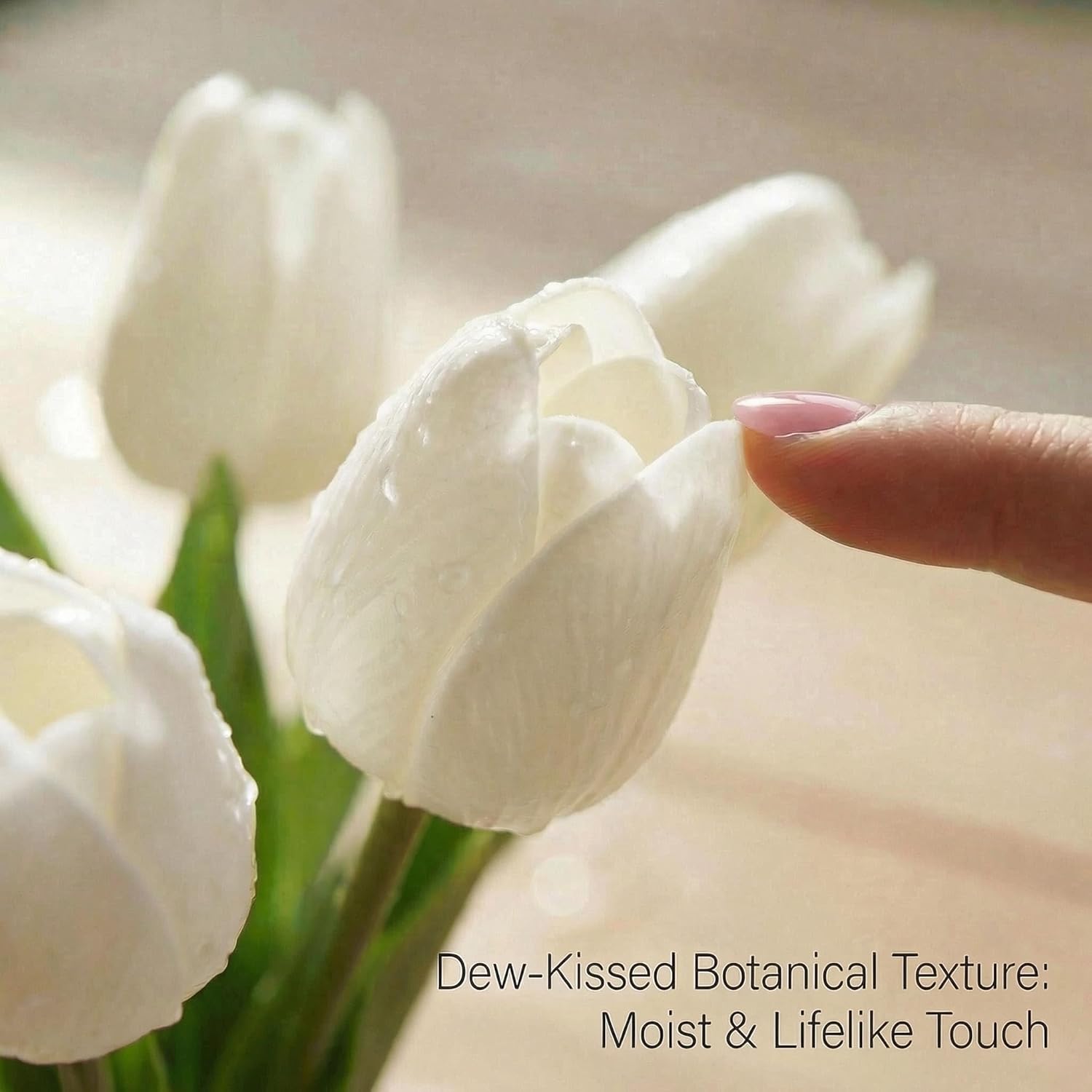
Tulips have a relatively simple silhouette — a smooth, cupped bloom with six petals, a clean stem, and elongated leaves that clasp the stalk. That simplicity is a double-edged sword. It means cheaper manufacturers can produce a passable tulip without sophisticated tooling. But it also means any flaw in petal texture or stem rigidity reads immediately, because there’s nothing complex to hide behind. The consistent complaint about budget tulip stems, noted in House Beautiful’s roundup “Best Fake Flowers That Actually Look Real,” is that the petals are too uniformly glossy — real tulip petals have a soft, slightly matte interior and a subtler sheen on the outside. Mid-range and premium stems solve this with a two-tone polysilk construction or a real-touch latex coating, which is a poured silicone-latex layer that mimics organic surface texture.
Cherry blossom branches are a different challenge entirely. The bloom itself — tiny, five-petaled, pale pink to white — is simple enough. What makes or breaks a faux cherry blossom is the branch structure: the number of lateral stems, the density of bloom clusters, and whether the buds at branch tips are present and varied in size. Real cherry blossom branches have a mix of fully open blooms, half-open blooms, and tight buds on the same branch, giving them a layered, alive quality. Apartment Therapy’s styling guide “How to Make Fake Flowers Look Real” specifically flags branch variety as the single biggest realism marker for blossom-type stems — more so than the flowers themselves. A budget branch with every bloom at identical fullness reads as artificial from across the room. A quality branch with graduated bud staging looks convincing in a floor vase from a normal viewing distance.
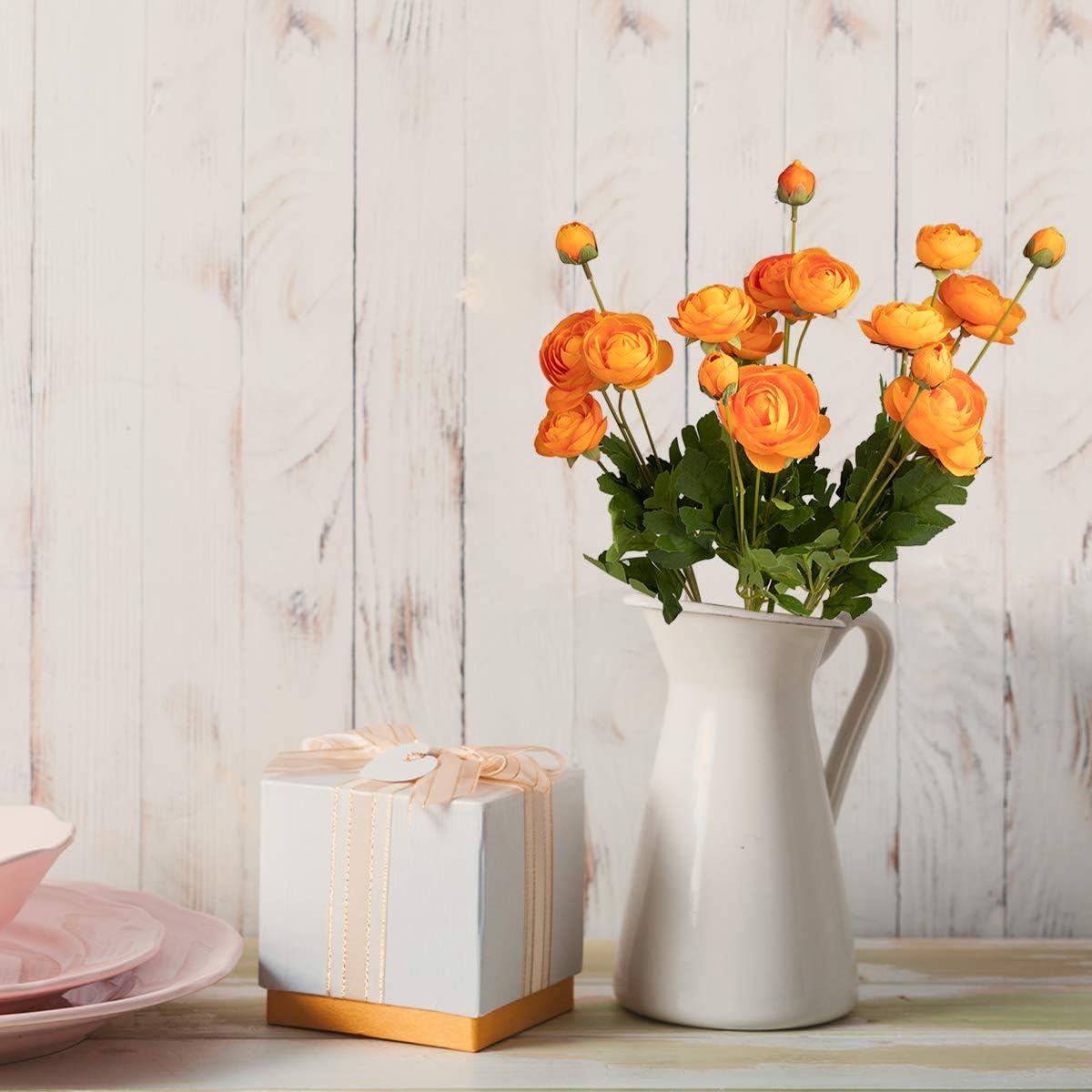
Ranunculus is the hardest of the three to fake well, and also the one where spending more money pays off most obviously. The bloom is made up of dozens of tightly packed, tissue-thin petals in concentric rings — structure that’s genuinely difficult to replicate in polysilk without the layers looking stiff or the color looking flat. Real-touch ranunculus, which uses a poured latex process applied to individual petals, holds up better because each petal can flex and catch light independently. At the entry level, ranunculus is the stem type most likely to disappoint a buyer who was hoping for something convincing in a tabletop vase — which is worth knowing before you order.
Construction Tiers: What the Price Difference Actually Buys You
Here’s a practical breakdown of what you’re paying for at each price tier, specific to these three stem types. This section uses H3 subsections so you can jump directly to the budget that applies to you.
Entry-Tier Stems ($6–$14 per stem or bundle)
At this price point, you’re working with standard polysilk — a woven synthetic fabric heat-pressed into petal shapes — and injection-molded plastic for structural leaf detail. Stems are wire-core with a basic wrapped or plain finish.
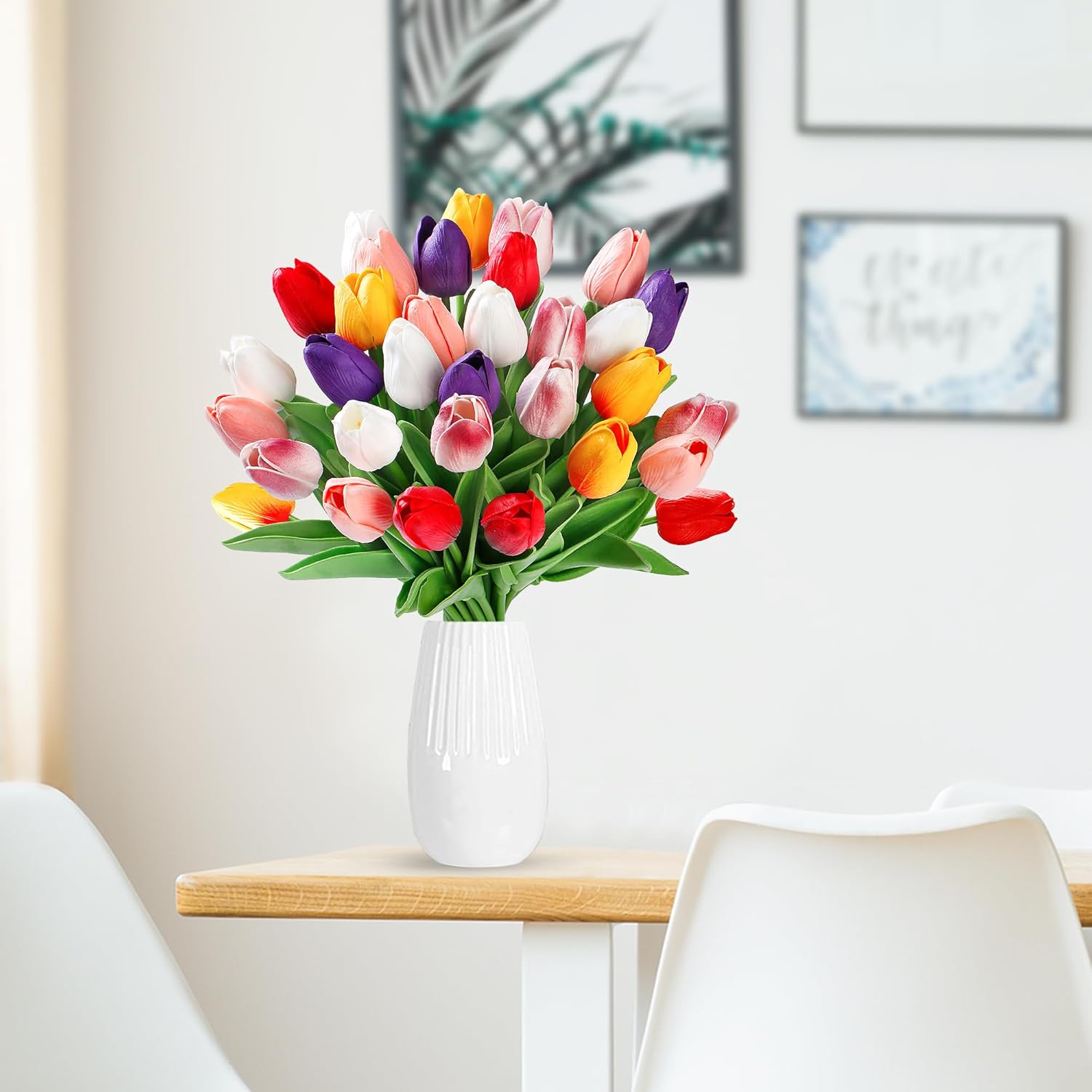
Tulips are the strongest performer at entry price because the petal count is low and the shape is forgiving. A smooth cupped bloom in polysilk reads as a tulip even when construction quality is modest, provided you choose colors that stay close to natural tulip tones (white, yellow, coral, deep red) rather than novelty gradients that amplify the artificial quality.
Cherry blossom branches at entry price often have adequate bloom density but tend toward uniform bloom size throughout the branch, which undercuts the layered-alive quality that makes real cherry blossom distinctive. If your display context is a tall floor vase viewed from eight or more feet away, this uniformity matters less. For a desktop or side-table vase, it shows.
Ranunculus at entry price almost universally draws critical reviews for stiff petal layers and oversaturated, flat color. Reviewers across major retail platforms consistently describe entry-tier ranunculus as “too perfect” in a way that reads immediately as plastic. If your budget is firm at this level, substitute ranunculus with entry-tier peonies, which have a similarly full bloom but a slightly more forgiving construction at low price points.
5
$14.99
In stock on Amazon
Check price on AmazonMid-Range Stems ($15–$35 per stem or branch)
This is the tier where cherry blossom branches make their biggest realism jump, and where tulips gain the textural upgrade that matters most for close-proximity display.
Cherry blossom branches at mid-range, from brands including Nearly Natural and Afloral — both regularly featured in House Beautiful’s artificial flower roundups and Brides’ wedding florals coverage — offer graduated bud-to-bloom ratios and branch articulation that allows you to bend and fan the branch before installation for a more naturalistic silhouette. The branch tip detail (tight, unopened buds rather than miniature versions of the full bloom) is the specific construction upgrade you’re paying for here, and it’s visible in product photos if you know to look for it.
Tulips at mid-range gain real-touch treatments on the petal interior, which is the detail that matters most for vases displayed at arm’s length. Interior petal texture — the soft, slightly velvety surface of a real tulip’s inner petal — is what the eye catches first when the flower is at viewing distance, and the mid-range real-touch upgrade addresses exactly this. Apartment Therapy’s guide on making faux flowers look convincing specifically calls out petal surface texture as more important than overall shape for realism at close range.
Ranunculus at mid-range improves over entry but the petal layering still tends toward regularity — the concentric rings read as too evenly spaced. A skilled arranger can compensate by mixing ranunculus stems at slightly different head angles and pairing them with looser textural stems (eucalyptus, anemone) to break up the visual regularity. As a standalone stem, mid-range ranunculus reads as intermediate quality.
Mandy's
$19.99
In stock on Amazon
Check price on AmazonPremium Stems ($36–$80+)
At this tier, the ranunculus investment pays off most clearly, and cherry blossom branches scale into architectural statement pieces suitable for large-format display.
Ranunculus at premium uses real-touch latex petals that are individually cast rather than stamped from a flat sheet — a slower, more material-intensive process that produces the subtle translucency and petal-edge irregularity that characterizes a real bloom. Architectural Digest’s editorial coverage of faux and preserved botanicals (“The Best Artificial Plants and Flowers That Look Incredibly Real”) consistently places real-touch ranunculus from specialist suppliers in the same category as preserved botanicals for visual quality at arm’s length. The tonal variation you see in a real ranunculus — deeper, richer color at the center graduating to lighter, almost translucent outer petals — is the detail that separates premium from mid-range, and it’s achievable in latex construction at this tier.
Cherry blossom branches at premium are primarily distinguished by scale and branch architecture complexity rather than bloom-level construction. Longer branches (48 inches and above) with multiple lateral branch generations — sub-branches coming off sub-branches — create the kind of gestural, architectural presence that interior designers cited in Architectural Digest use in large-scale residential and hospitality installations. For a desktop vase, the premium branch is largely overkill. For a floor vase, a mantel, or an event installation, it’s the correct tool.
Tulips at premium are largely overkill for home use unless you’re working at hospitality scale, where stems will be examined at very close range repeatedly over time. A mid-range real-touch tulip performs equivalently for most home display contexts, and the savings are real.
For preserved botanicals — actual flowers preserved through a glycerin-and-dye process rather than manufactured synthetically — pricing extends well above this tier. Architectural Digest’s interiors coverage places preserved florals in the same design category as art objects in terms of how designers approach their placement and care. That’s a separate purchase category from what most home buyers are shopping for, but worth knowing as the ceiling of the realism spectrum.
Sggvecsy
$21.99
In stock on Amazon
Check price on AmazonVase Context: Which Stem Type Wins Where
Construction tier matters, but display context should drive your initial stem-type decision. This is the frame most buying guides skip.
Glass vases, any size: All three stem types face maximum scrutiny in clear glass because the stem and any visible water-simulation medium (clear acrylic gel is standard for faux arrangements) is fully exposed. Tulip stems have a structural advantage here — their clean, smooth stems with minimal branching are easy to dress convincingly. Cherry blossom branches in glass look best at medium to large vase scale where the branch architecture creates an architectural moment above the vase lip; in a narrow-neck bud vase, the branch base can look cluttered. Ranunculus in glass benefits from being grouped — three to five stems together in a wide-mouth cylinder reads as a deliberate arrangement, while a single stem can look sparse.
Opaque ceramic or stoneware vases: This context is the most forgiving. When the stem is hidden from the base up, you’re evaluating only the bloom and the upper stem, which narrows the realism test considerably. This is where mid-range tulips and cherry blossom branches compete very effectively with premium alternatives. Apartment Therapy’s styling coverage on faux botanicals names vase opacity as the highest-impact single technique for making artificial stems look convincing — hide what needs hiding, and the bloom does the rest.
Tall floor vases and architectural display: Cherry blossom branches win this category without serious competition. A well-constructed branch at the $25–$45 range, properly bent and fanned before installation, fills a tall vase with the kind of seasonal gesture that reads as intentional design. At this viewing distance and scale, individual bloom scrutiny is low because the overall composition dominates — which is why mid-range branches perform nearly as well as premium ones in this specific context, and why event designers working at volume consistently cite cherry blossom branches as the spring stem with the best cost-per-visual-impact ratio.
The Realism Checklist: What to Look for in Product Photos
Most purchases in this category happen online without physical inspection, so reading a product photo is a core skill.
Tulips: Look for a slightly different finish on the petal interior versus exterior — the interior should read softer and more matte than the outer surface. Check that leaf texture shows vein detail rather than a smooth plastic sheen. The stem should show slight color variation (pale striations of lighter green) rather than uniform flat green along its entire length.
Cherry blossom branches: Count the bloom stages visible in the product photo — you want open flowers, half-open flowers, and tight buds all present on the same branch. Look at branch tips specifically; entry-level branches often terminate in clusters of identical open blooms, while quality branches taper to small, closed buds. Check whether the product photos show bent or fanned branch configurations, which indicates the branch wire is designed for shaping rather than fixed in a single position.
Ranunculus: Look at the petal edges in close-up photos — real-touch latex petals show slight irregularity and visible translucency at the thin outer edge of each petal. If every petal appears to be an identical stamped shape with opaque, uniform color throughout, it’s likely standard polysilk. Color depth is the other key marker: quality ranunculus shows tonal variation from the center outward, with deeper saturation at the center and lighter, almost washed tones at the outer petals. Brides’ coverage of artificial wedding florals and House Beautiful’s roundups both identify this center-to-edge color graduation as the primary visual marker distinguishing premium from mid-range ranunculus at first glance.
The Decision Rule
If you’re staging a glass vase at arm’s length — a dining table, a side table, a desk — and budget is flexible, ranunculus in real-touch latex is the investment worth making. The bloom complexity that makes it difficult to manufacture well is also what makes it arresting when done right.
If you’re filling vertical space — a floor vase, a mantel, a wedding arch — or buying at volume for an event, cherry blossom branches at the mid-range tier give you the best return on spend. They punch well above their price point at architectural scale, a pattern that interiors editors at both Architectural Digest and House Beautiful have reinforced across multiple seasonal roundups.
If you want something clean, uncomplicated, and reliable across every context — a stem that works in a bud vase, a bundle arrangement, or a craft project without demanding much from you — tulips at mid-range are the lowest-risk buy. They don’t have the drama of a ranunculus or the architectural presence of a cherry blossom branch, but they don’t disappoint either. Sometimes the dependable choice is the smart one.