May 9, 2026 • Celeste Morrow • 8 min reading time • Prices verified June 6, 2026
Preserved Roses in a Box: Decoding Longevity Claims and Finding the Gift That Actually Lasts
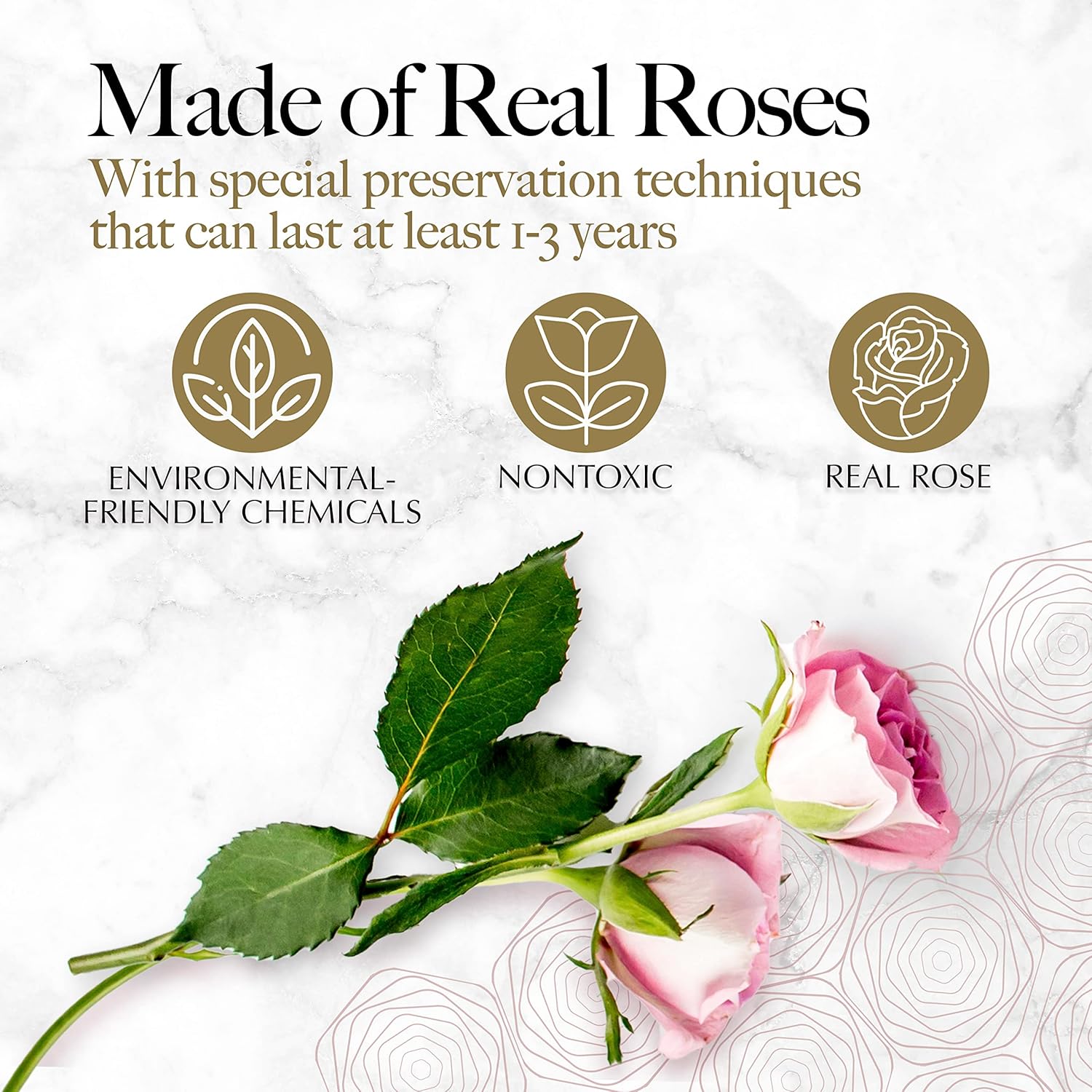
If you’ve ever received a hat box of roses that still looked perfect weeks after fresh flowers would have wilted, you’ve encountered preserved roses — real roses that have been harvested at peak bloom and treated with a plant-based glycerin solution that replaces their natural moisture. The glycerin keeps the petals soft and flexible indefinitely, without water or sunlight. The result is a bloom that looks and feels almost exactly like a fresh rose but doesn’t die. Brands like Venus ET Fleur and Primrose London have built entire luxury businesses on this premise, with single arrangements selling for $200–$600 and up. The pitch is simple: pay more once, enjoy it for years. But “years” is doing a lot of work in that sentence — and if you’re sourcing these for a client, a hospitality install, or a high-stakes gift, you need to know exactly what that claim means before you commit.
This guide breaks down how longevity claims are made (and sometimes stretched), what the real variables are, and how to match the right product tier to the right use case.
| EDITOR'S PICK[Eterfield 47 Preserved Roses in…](https://www.amazon.com/dp/B0D838RBP7?tag=greenflower20-20) | Mid-tier[Forever Preserved Rose - Eterna…](https://www.amazon.com/dp/B083BVMPL8?tag=greenflower20-20) | Budget pick[Impouo 16-Piece Preserved Rose…](https://www.amazon.com/dp/B0CC5VFZNT?tag=greenflower20-20) | |
|---|---|---|---|
| Rose count | 47 | 1 | 16 |
| Display type | Heart box | Glass dome | — |
| Height | — | 9 in | — |
| Price | $74.79 | $39.99 | $36.99 |
| See on Amazon → | See on Amazon → | See on Amazon → |
What “Lasts 1–3 Years” Actually Means — and Where Brands Hedge
The most common longevity window you’ll see marketed is one to three years, with some premium brands claiming up to five. Understanding what conditions that range assumes is the single most important skill in this category.
Good Housekeeping’s 2024 feature on preserved flowers lays out the baseline clearly: preserved roses retain their appearance longest when kept out of direct sunlight, away from humidity, and in a stable temperature environment — roughly 60–75°F with relative humidity under 60%. These are indoor climate-controlled conditions. Under those parameters, one to three years is a reasonable expectation for quality product.
The hedge most brands bury in their care guides: color fade and petal brittleness accelerate sharply outside those parameters. A bedroom in a humid climate, a bathroom shelf, a sunny windowsill, a venue lobby with fluctuating HVAC — any of these can compress the practical lifespan to six to twelve months. The Spruce’s care guide for preserved roses is specific about this: they note that humidity is the primary enemy, because the glycerin that keeps petals soft is hygroscopic — it absorbs ambient moisture, which can make petals feel tacky, cause color bleed between dyed varieties, and eventually lead to mold in high-humidity environments.
What this means for your sourcing decisions:
- For a gift to a private client in a well-maintained home: the 1–3 year claim is realistic.
- For a hotel lobby install, a retail display, or a venue with variable HVAC: budget for replacement at 12–18 months and price the project accordingly.
- For outdoor or semi-outdoor use: preserved roses are the wrong product entirely. Direct them to UV-stabilized silk instead.
The Longevity Tier Breakdown: What Price Is Actually Buying You
Not all preserved roses are preserved the same way. The price gap between a $60 box from a mid-market retailer and a $400 Venus ET Fleur arrangement isn’t purely branding — there are real material and process differences that affect longevity.
By the numbers — preserved rose price tiers as of mid-2026:
| Tier | Typical Price Range | Rose Origin | Preservation Method | Realistic Lifespan |
|---|---|---|---|---|
| Entry / mass market | $30–$80 | Unspecified / mixed origin | Industrial glycerin batch | 6–12 months |
| Mid-market | $80–$200 | Ecuador / Colombia stated | Glycerin + colorfast dye | 1–2 years |
| Premium / luxury | $200–$600+ | Ecuador, single-farm stated | Proprietary multi-step | 2–4 years |
Rose origin matters because Ecuadorian roses — grown at high altitude in low-humidity conditions — have denser, more compact petals that absorb preservation solutions more uniformly. Reviewers on aggregated retail platforms consistently note that arrangements listing Ecuador as the rose source tend to hold color and texture longer than those with unspecified origins.
The preservation process itself is where brands differentiate most at the top tier. Venus ET Fleur’s proprietary process — referenced in Architectural Digest’s 2025 luxury floral gift editorial — involves multiple stages of treatment and a final coating that stabilizes petal texture and slows color fade. The result is a petal that owners consistently describe as softer and more tactile than mid-market alternatives years into ownership. Primrose London makes similar claims about their process and specifies Colombian-grown roses processed in the UK.
What you’re not paying for at the premium tier: a dramatically better hat box or ribbon. The packaging at $400+ is beautiful, but the cost-per-year math only works if the rose quality and preservation process actually deliver on the extended lifespan claim. If you’re sourcing for a client who will display the arrangement in ideal conditions, the premium tier justifies itself. If the environment is compromised, you’re paying luxury prices for mid-tier longevity.
How to Read a Product Page for Real Longevity Signals
Most buyers at the intermediate level can identify a beautiful product photo. The skill gap is reading the description for what it doesn’t say. Here’s the decision framework.
Green flags — signals of genuine longevity:
- Named rose origin (Ecuador, Colombia, Kenya) with specificity about farm or region. Vague “natural roses” language is a yellow flag.
- Explicit humidity and UV warnings in the care instructions. Brands that know their product list these prominently because they’ve seen the failure modes.
- Multi-step preservation language — glycerin treatment, dehydration phase, color stabilization, finish coat. One-step “glycerin preserved” language at a $300 price point is worth scrutinizing.
- Clear replacement / damage policy. Brides’ 2025 roundup of preserved flower arrangements specifically highlights that top-tier brands offer damage-in-transit claims and, in some cases, partial color-fade guarantees within the first year. If a brand at $400+ has no stated damage policy, that’s worth noting.
Red flags — claims that should prompt questions:
- “Lasts forever” language without qualification. No preserved organic material lasts forever; this is a marketing phrase, not a spec.
- “Up to 5 years” claims on sub-$100 product. That longevity ceiling requires specific rose quality and preservation investment that can’t be delivered at that price point.
- No care instructions included or linked. Legitimate preserved rose brands lead with care information because improper handling is their #1 return driver.
- Unspecified colorants. Dyed preserved roses — the vivid blues, blacks, rainbow-ombre varieties — use post-preservation colorants. Some are more lightfast than others. At the premium tier, brands specify colorfast dyes; at the entry tier, reviewers across multiple platforms note noticeable fading within three to six months on non-natural colors.
Matching Product to Use Case: The Decision Rules
Here’s where the practitioner framework tightens. You have a decision in front of you. Apply the right filter.
If you’re sourcing a gift for a specific individual with a known living environment: Ask one qualifying question — “Does the space get direct afternoon sun or is it humid?” If no to both, mid-market to premium is appropriate and the longevity claim holds. If yes to either, steer toward a premium brand with a strong finish coat, or reset expectations to 12–18 months upfront and let the client decide.
If you’re specifying for a hotel lobby or commercial interior: Preserved roses are viable in climate-controlled lobbies with indirect lighting. Budget for 18-month replacement cycles regardless of brand claims — foot traffic, cleaning staff, and air system variation accelerate wear. For any space with direct sunlight or seasonal humidity variation, high-grade silk from Winward Silks or comparable trade-grade manufacturers is the more defensible spec: the longevity is predictable, cleaning is straightforward, and color stability under UV is engineerable. Preserved roses in commercial contexts are a premium touch, but the maintenance commitment needs to be in the contract.
If you’re selecting a wedding or event arrangement: For a one-day event or short-term display (under a week), preserved roses are exceptional — they photograph beautifully, don’t wilt under heat or handling, and travel well in their boxes. For arrangements intended as keepsakes that guests take home, the longevity math depends entirely on what those guests do with them. Consider including a printed care card; brands that supply these see fewer post-event complaints, per aggregated vendor reviews on event planning platforms.
If you’re evaluating a $400+ purchase for a client and need to justify the cost: The cost-per-year math at a two-year lifespan on a $400 arrangement is $200/year, or roughly $16/month. Against a fresh flower subscription at comparable visual impact ($60–$120/month), the preserved option wins on cost and maintenance by a significant margin — provided the environment is right. Make that math explicit in your client presentation. Architectural Digest’s 2025 editorial on luxury florals frames preserved roses precisely this way: as a long-cycle investment rather than a consumable, comparable to a quality textile or a piece of art.
The Honest Bottom Line
Preserved roses in a box are genuinely remarkable when the product is good and the environment cooperates. The longevity claims are real — within the right conditions. The category’s credibility problem is that “1–3 years” is marketed uniformly across products whose actual quality range would more honestly span “6 months in a damp apartment” to “4 years on a well-ventilated shelf.” Your job as a practitioner is to close that gap for your clients.
The decision rules in plain terms:
- Premium brand + named Ecuadorian roses + climate-controlled interior = lean into the longevity claim with confidence
- Mid-market brand + unnamed origin + real-world home environment = frame as 1–2 year product, not indefinite
- Any preserved rose + humidity or direct sun = wrong product; specify UV-stable silk instead
- Commercial install regardless of brand = 18-month replacement cycle in the budget, always
The gift that actually lasts isn’t just about buying the most expensive box. It’s about matching preservation quality to environment honestly — and being the person who told the client the truth before anything faded.